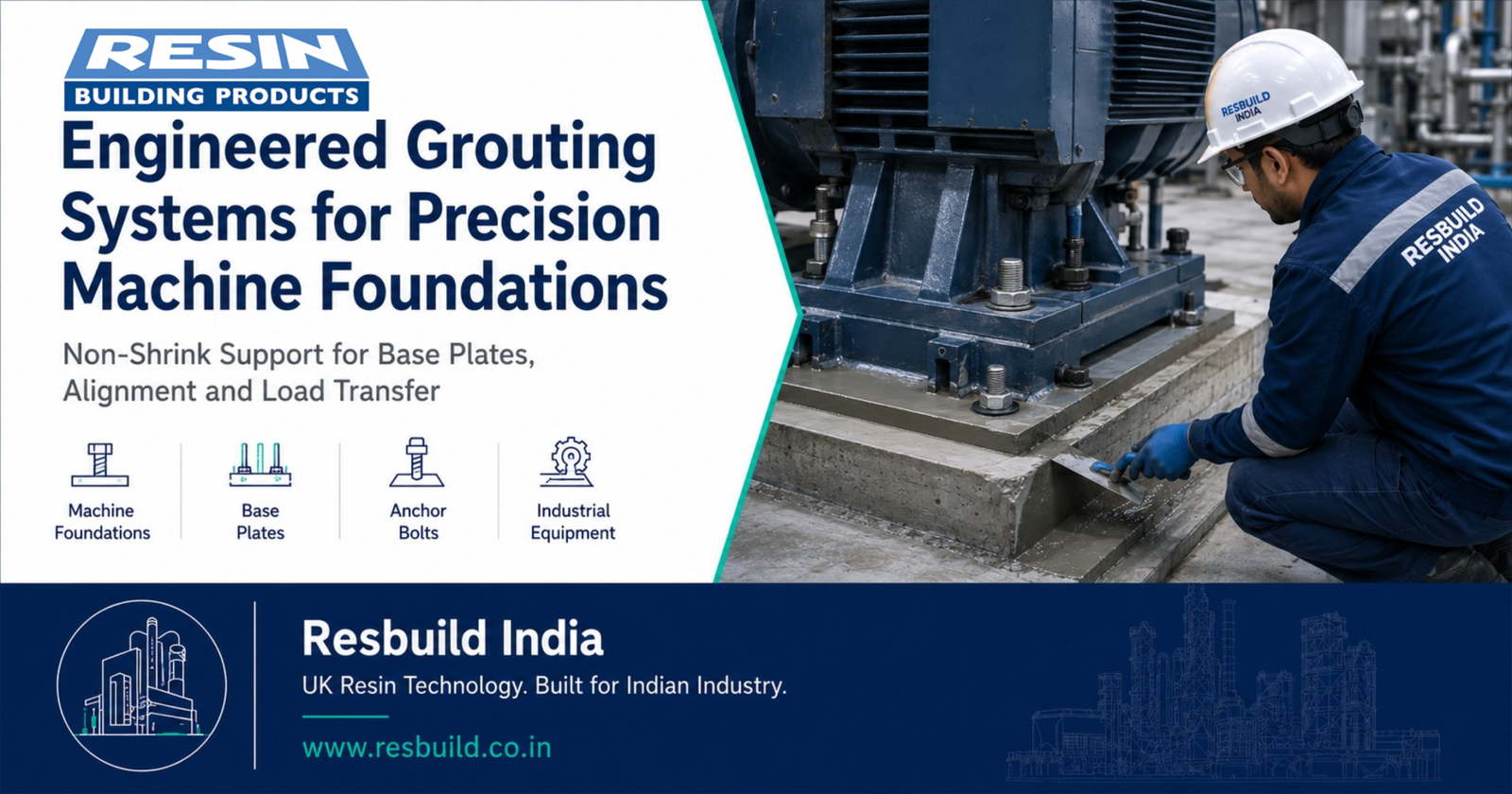
Engineering Grouts for Machine Foundations and Base Plates
Machine foundations and base plates require more than high concrete strength. The space between the equipment base and concrete foundation must be filled with a suitable engineering grout that can provide complete contact, reliable load transfer, dimensional stability, and long-term support.
If the grout shrinks, develops voids, loses contact, or lacks sufficient strength, the performance of the complete installation may be affected. This can contribute to machinery misalignment, vibration, uneven load distribution, anchor bolt stress, premature wear, and repeated maintenance.
For this reason, engineering grout selection should be treated as a critical part of machine installation rather than a routine gap-filling activity.
Resbuild Engineering Grouts provide high-strength, non-shrink precision grouting support for machinery, base plates, anchor bolts, structural steel, and industrial installations.
What Is an Engineering Grout?
Engineering grout is a specially formulated material used to fill load-bearing spaces between equipment, structural elements, and concrete foundations.
Unlike ordinary cement mortar, a properly designed engineering grout is intended to provide:
- Controlled flow and placement
- High compressive strength
- Non-shrink performance
- Complete contact below base plates
- Reliable load transfer
- Resistance to service conditions
- Consistent factory-controlled performance
Engineering grouts may be used below machine base plates, turbines, pumps, compressors, steel columns, bridge bearings, rails, precast elements, anchor bolts, and industrial equipment.
Why Machine Foundation Grouting Matters
A machinery base plate may appear to rest directly on a concrete foundation, but small irregularities, level differences, and installation gaps usually remain between the steel and concrete surfaces.
Engineering grout fills these spaces and creates a stable load-bearing interface.
Correctly placed grout helps:
- Transfer equipment loads into the foundation
- Maintain contact below the base plate
- Support machinery alignment
- Reduce concentrated stress
- Fill irregularities and inaccessible spaces
- Stabilise anchor bolts and structural elements
- Improve long-term operational reliability
Poor grouting can leave unsupported zones below the base plate. These voids may increase local stress and allow movement during operation.
Why Non-Shrink Performance Is Important
Conventional cement-based materials can lose volume during drying and hydration. If shrinkage occurs below a machine base plate, contact between the grout and steel plate may be reduced.
A non-shrink grout is designed to compensate for volume change and maintain effective contact after placement.
This is particularly important for:
- Precision machinery
- Dynamic equipment
- High-load installations
- Base plates with limited access
- Large grout gaps
- Anchor bolt pockets
- Structural steel supports
- Equipment requiring accurate alignment
Non-shrink performance does not eliminate the need for correct placement. The substrate, formwork, mixing, flow path, and curing must also be controlled.
Key Factors in Engineering Grout Selection
No single grout is suitable for every machine foundation. Product selection should consider the actual installation conditions.
1. Grout Gap and Section Thickness
The distance between the concrete foundation and the underside of the base plate affects grout flow, heat development, and placement.
Thin gaps require a grout with suitable flow and particle grading. Deep sections may need a material designed for greater thickness or controlled aggregate addition.
The grout thickness should always remain within the limits stated in the product technical data sheet.
2. Base Plate Size and Geometry
Large base plates may require grout to travel a considerable distance. Stiffeners, anchor bolts, shims, and restricted access can obstruct flow.
The grout must have sufficient flowability to move through the installation without segregation or trapped air.
3. Compressive Strength
Compressive strength is important, but it should not be considered alone.
The grout should achieve strength appropriate for the concrete foundation, base plate, loading conditions, and installation schedule. Excessive focus on very high strength without considering flow, shrinkage, or application conditions may result in unsuitable selection.
4. Static or Dynamic Loading
Static installations and high-vibration machinery may require different grout properties.
Pumps, turbines, compressors, crushers, and rotating equipment can expose grout to repeated movement and vibration. The full system should be selected according to the service conditions.
5. Working Time and Site Temperature
Temperature affects grout consistency, flow, working time, and strength development.
Hot Indian site conditions may shorten working time, while low temperatures can slow early strength development. Mixing water, storage conditions, equipment, and application planning should be controlled accordingly.
6. Required Return-to-Service Time
Industrial shutdowns are often time-sensitive. The required time for equipment installation, bolt tightening, alignment checks, and commissioning should be considered before selecting the grout.
Early-strength requirements must be confirmed through the product data and project specification.
7. Chemical and Moisture Exposure
Machine foundations may be exposed to oils, process chemicals, washdown water, moisture, or aggressive industrial environments.
The selected grout and any protective treatment should be suitable for the expected exposure.
Typical Applications of Resbuild Engineering Grouts
Resbuild Engineering Grouts may be considered for:
- Machine foundations
- Equipment base plates
- Pumps and compressors
- Turbines and generators
- Industrial presses
- Steel column base plates
- Anchor bolt pockets
- Rail and crane track installations
- Precast structural elements
- Bridge bearing applications
- Industrial maintenance and refurbishment
- Structural void filling
Final product selection should be based on installation dimensions, load requirements, environment, and application method.
Surface Preparation for Machine Foundation Grouting
Proper surface preparation is essential for reliable grout performance.
The concrete foundation should be:
- Structurally sound
- Free from weak laitance
- Clean and uncontaminated
- Free from oil, grease, dust, and loose particles
- Adequately roughened where required
- Prepared according to the grout specification
The underside of the base plate should also be clean and free from loose rust, oil, and contaminants.
For cementitious grouts, the concrete substrate may require pre-saturation while avoiding standing water. The exact preparation should follow the product technical data sheet.
Formwork and Grout Placement
Formwork must be rigid, sealed, and capable of resisting grout pressure.
Leakage can reduce grout volume and create incomplete filling. The formwork should provide suitable head pressure and allow continuous placement from one side.
Important placement principles include:
- Mix the complete bag wherever possible
- Use measured, clean water
- Use the recommended mixing equipment
- Do not exceed the stated water dosage
- Place continuously from one direction
- Maintain a steady grout head
- Avoid excessive vibration
- Provide air-release points where necessary
- Do not retemper grout after initial mixing
Pouring from one side helps push air outward and reduces the risk of trapping voids below the plate.
Common Grouting Problems and Their Causes
Voids Below the Base Plate
Possible causes include inadequate flow, interrupted placement, poor formwork design, insufficient head pressure, or trapped air.
Excessive Shrinkage
This may result from unsuitable material selection, excess water, poor curing, or use of ordinary mortar instead of non-shrink grout.
Cracking
Cracking may be caused by excessive section thickness, rapid drying, high water content, movement, incorrect curing, or unsuitable grout selection.
Low Strength
Possible causes include excess mixing water, poor mixing, low temperatures, contamination, incorrect proportions, or early loading.
Loss of Alignment
Alignment problems may result from unstable shims, movement during placement, incomplete support, poor grout contact, or premature equipment operation.
Quality Control During Grouting
A controlled grouting procedure should include:
- Verification of foundation level
- Inspection of substrate preparation
- Formwork checks
- Water measurement
- Mixing-time control
- Flow or consistency testing where required
- Cube or strength testing when specified
- Recording ambient and substrate temperature
- Inspection for leakage and voids
- Curing control
- Final alignment verification
For critical installations, the grout application should be supervised by experienced technical personnel.
Why Use a System-Based Grouting Approach?
Engineering grout performance depends on more than the product itself.
A complete grouting system includes:
- Foundation assessment
- Surface preparation
- Base plate and anchor bolt cleaning
- Formwork design
- Correct grout selection
- Controlled mixing
- Continuous placement
- Proper curing
- Inspection and testing
- Commissioning at the correct time
Treating these steps as one coordinated process helps reduce installation risk and improve long-term reliability.
Resbuild Engineering Grouts
Resbuild India supports EPC contractors, industrial maintenance teams, machine installers, consultants, and project owners with high-strength, non-shrink precision grouting systems.
Our technical approach focuses on selecting the right grout according to:
- Gap depth
- Base plate dimensions
- Required strength
- Flow distance
- Working time
- Loading conditions
- Chemical exposure
- Installation schedule
- Site environment
For product selection, always refer to the relevant TDS and project requirements.
Request Technical Guidance
Need help selecting an engineering grout for a machine foundation, base plate, anchor bolt, or structural installation?
Connect with Resbuild India for:
- TDS and SDS
- Technical product selection
- Site consultation
- Application guidance
- Applicator inquiry
- Distributor inquiry
Product page:
https://resbuild.co.in/resbuild-engineering-grout
Contact:
+91 98796 13029
Resbuild India
UK Resin Technology. Built for Indian Industry.
Frequently Asked Questions
What is the purpose of non-shrink grout below a base plate?
Non-shrink grout fills the gap between the base plate and concrete foundation while maintaining contact, supporting load transfer, and reducing shrinkage-related voids.
Can ordinary cement mortar be used for machine foundations?
Ordinary cement mortar may shrink, lack sufficient flow, and provide inconsistent support. Critical machine foundations generally require a properly specified engineering grout.
How thick can engineering grout be applied?
Permitted thickness depends on the individual product. The minimum and maximum application depths must be checked in the relevant TDS.
Why should grout be poured from one side?
One-direction placement helps push air out of the grout space and reduces the risk of trapping voids below the base plate.
Is high compressive strength the only selection factor?
No. Flowability, non-shrink performance, working time, gap size, loading, exposure conditions, and application method are also important.
Can engineering grout be used for anchor bolts?
Certain engineering grouts may be suitable for anchor bolt pockets and structural void filling. Product suitability should be confirmed from the technical data.
When can machinery be started after grouting?
Commissioning time depends on grout strength development, temperature, load, equipment requirements, and project specifications. The relevant TDS and engineering instructions should be followed.