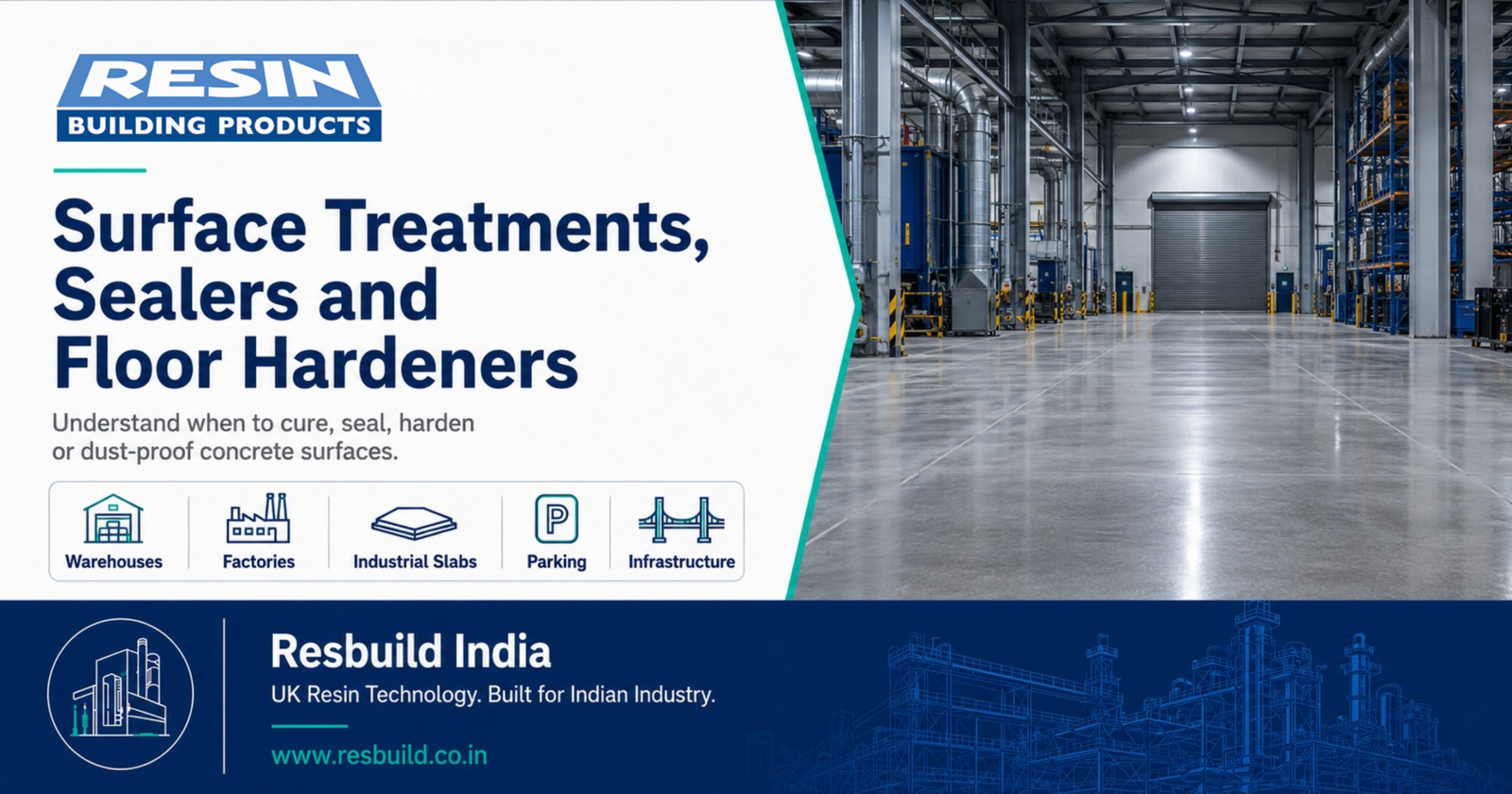
Surface Treatments, Sealers and Floor Hardeners: When to Use What
Concrete may appear to be a simple construction material, but its long-term surface performance depends heavily on how it is placed, cured, finished and protected.
Industrial floors, warehouse slabs, parking areas, loading zones and infrastructure surfaces can face dusting, abrasion, oil contamination, moisture exposure, staining and repeated mechanical traffic. Choosing the correct surface treatment can help improve durability, reduce maintenance requirements and support better service performance.
However, curing compounds, sealers, dust-proofing treatments and floor hardeners do not perform the same function. Each system addresses a different stage or requirement.
This guide explains when each type of concrete surface treatment should be considered and how contractors and industrial buyers can select a suitable system.
Why Concrete Surface Treatment Matters
A concrete slab is exposed to several risks from the time it is placed.
During early curing, rapid moisture loss can affect hydration and surface development. After the slab enters service, traffic, abrasion, chemicals, oils and cleaning can gradually damage the surface.
Common concrete surface problems include:
- Surface dusting
- Premature wear
- Weak or friable surface laitance
- Staining from oils or liquids
- High water absorption
- Poor curing
- Abrasion caused by forklifts or material movement
- Difficulty maintaining a clean industrial environment
A suitable surface treatment can help reduce some of these risks, but the correct product must be selected according to the actual requirement.
1. Curing Compounds: For Freshly Placed Concrete
Curing compounds are used soon after concrete finishing to help reduce moisture loss from the surface.
Concrete needs sufficient moisture for cement hydration. If water evaporates too quickly, especially in hot, dry or windy conditions, the surface may not develop as intended.
When to Use a Curing Compound
A curing compound may be considered for:
- Industrial floor slabs
- Warehouse slabs
- Roads and pavements
- Parking decks
- Large concrete pours
- External concrete surfaces
- Infrastructure projects
- Areas where water curing is difficult to maintain
Main Function
The purpose of a curing compound is to create a temporary membrane that helps retain moisture within the concrete.
It is primarily a curing-support product. It should not automatically be treated as a long-term abrasion-resistant coating or decorative sealer.
Important Selection Factors
Before selecting a curing compound, confirm:
- Whether the surface will receive another coating
- Whether the curing membrane must be removed later
- The application rate
- Surface temperature and weather conditions
- Compatibility with subsequent flooring or coating systems
- Whether internal or external application is intended
If a resin flooring or protective coating will later be installed, compatibility must be reviewed carefully. Residual curing material may interfere with adhesion if it is not suitable or properly removed.
2. Concrete Sealers: For Surface Protection and Reduced Absorption
Concrete sealers are generally used after the concrete has hardened and reached the condition required for treatment.
A sealer can help reduce surface absorption and make the concrete easier to maintain. Depending on the chemistry, it may form a film or penetrate into the concrete.
When to Use a Concrete Sealer
Concrete sealers may be suitable for:
- Warehouse floors
- Utility areas
- Parking areas
- Production support zones
- Commercial concrete floors
- Industrial workshops
- Service corridors
- Concrete surfaces requiring easier cleaning
Main Functions
Depending on the product type, a sealer may help:
- Reduce liquid absorption
- Improve resistance to staining
- Reduce surface dust
- Enhance surface appearance
- Support easier cleaning
- Provide limited protection against oils and contaminants
A sealer should not be assumed to provide the same performance as a heavy-duty resin flooring system. Where strong chemical resistance, impact resistance, hygiene or high mechanical durability is required, an epoxy, polyurethane or MMA flooring system may be more suitable.
Penetrating Versus Film-Forming Sealers
Penetrating sealers enter the concrete pores and generally change the appearance less.
Film-forming sealers create a layer on the surface. They may provide a more visible finish but can wear under traffic and may require maintenance or reapplication.
Selection should consider:
- Traffic intensity
- Indoor or outdoor exposure
- Desired finish
- Slip resistance
- Cleaning methods
- Chemical contact
- Maintenance expectations
3. Dust-Proofing Treatments: For Concrete Surface Dusting
Concrete dusting occurs when a weak surface layer releases fine powder under traffic or cleaning.
This can affect warehouses, factories, storage areas and workshops. Dust may settle on machinery, stored materials, packaging and finished goods.
Common Causes of Concrete Dusting
Dusting can result from:
- Excess water at the surface during finishing
- Inadequate curing
- Weak concrete mix
- Premature finishing
- Carbonation of a weak surface
- Surface laitance
- Abrasion from traffic
- Poor finishing practices
When to Use a Dust-Proofing Treatment
Dust-proofing treatment may be considered where:
- The concrete is generally sound but releases fine dust
- A warehouse floor requires improved cleanliness
- Light-to-moderate traffic is causing surface powdering
- The user wants to improve maintenance without installing a thick coating
- The surface requires consolidation and reduced dust generation
The floor should be inspected before treatment. A dust-proofer cannot restore deeply damaged, delaminated or structurally weak concrete.
Weak areas may need mechanical removal and repair before any surface treatment is applied.
4. Liquid Floor Hardeners: For Surface Densification
Liquid floor hardeners are typically applied to hardened concrete. They penetrate the surface and react with available components in the cement matrix.
The treatment can help densify the surface and improve resistance to dusting and abrasion.
When to Use a Liquid Floor Hardener
Liquid hardeners can be suitable for:
- Existing warehouse slabs
- Distribution centres
- Factory floors
- Parking structures
- Concrete floors with light surface dusting
- Industrial slabs requiring improved surface durability
- Areas where a coating is not desired
Benefits
A suitable liquid hardener may help:
- Densify the concrete surface
- Reduce dusting
- Improve abrasion resistance
- Support easier maintenance
- Maintain a natural concrete appearance
- Reduce surface porosity
Performance depends on concrete quality, porosity, surface preparation and application rate.
Very dense concrete may absorb the product differently from porous concrete. Trial application may be useful where the surface condition is uncertain.
5. Dry-Shake Floor Hardeners: For Fresh Industrial Floors
Dry-shake floor hardeners are applied during the construction of fresh concrete floors.
They are distributed over the concrete surface and mechanically finished into the slab. They are commonly used where higher abrasion resistance is required.
When to Use a Dry-Shake Floor Hardener
Dry-shake hardeners are relevant for:
- Warehouses
- Factory floors
- Loading areas
- Logistics centres
- Workshops
- Parking structures
- Industrial production areas
- Floors exposed to forklift movement
Main Benefits
A properly applied dry-shake floor hardener can support:
- Improved surface abrasion resistance
- Better wear performance
- Reduced dusting
- More durable industrial floor finishes
- Increased resistance to repetitive traffic
The system must be included in the slab construction plan. It cannot normally be applied later in the same way as a liquid hardener.
Correct timing, dosage, finishing and curing are essential. Poor application can result in delamination, colour variation, weak patches or inconsistent performance.
6. Resin Sealers and Coatings: For Higher Protection Requirements
Where a concrete sealer or hardener does not provide enough protection, a resin-based floor coating may be required.
Epoxy and other resin systems can create a continuous protective layer over concrete.
Consider a Resin Coating When the Floor Needs
- Chemical resistance
- Seamless protection
- Improved hygiene
- Decorative colour
- Defined slip resistance
- Resistance to oils and aggressive cleaning
- Higher protection in production areas
- Easier contamination control
A resin coating should not be selected only by colour or generic product description. Substrate moisture, preparation, traffic, operating temperature and chemical exposure must be evaluated.
How to Select the Right Surface Treatment
Use the following decision framework.
Choose a Curing Compound When
The concrete is fresh and moisture retention during curing is the main requirement.
Choose a Concrete Sealer When
The concrete has hardened and reduced absorption, easier cleaning or light-duty surface protection is required.
Choose a Dust-Proofing Treatment When
The concrete is generally sound but releases fine surface dust.
Choose a Liquid Floor Hardener When
An existing concrete floor requires surface densification and improved resistance to wear and dusting.
Choose a Dry-Shake Floor Hardener When
A new industrial slab requires higher abrasion resistance during construction.
Choose a Resin Flooring System When
The application requires seamless protection, chemical resistance, hygiene, colour or higher operational durability.
Questions to Ask Before Product Selection
Contractors and industrial buyers should confirm:
- Is the concrete fresh or already cured?
- Is the problem dusting, absorption, wear or chemical exposure?
- What traffic will the surface receive?
- Will forklifts or steel-wheeled equipment operate in the area?
- Is the application internal or external?
- Will another coating be applied later?
- Is slip resistance required?
- What cleaning chemicals will be used?
- Is the substrate sound and properly finished?
- What maintenance interval is acceptable?
These questions help prevent the use of a light-duty treatment in an area requiring a heavy-duty system.
Common Selection Mistakes
Using a Sealer as a Heavy-Duty Floor Coating
A basic concrete sealer may not provide sufficient resistance for chemical processing or heavy industrial traffic.
Applying Treatment Over Weak Concrete
No surface treatment can fully compensate for unsound, delaminated or heavily contaminated concrete.
Ignoring Future Coating Requirements
Some curing compounds or sealers may need to be removed before installing resin flooring.
Selecting Only by Initial Price
The lowest-cost treatment may require frequent maintenance or early replacement.
Applying Without Testing the Surface
Absorption, moisture, contamination and surface hardness should be evaluated before application.
Resbuild Surface Treatments & Sealers
Resbuild Surface Treatments & Sealers support concrete curing, sealing, hardening and dust-proofing requirements across industrial, commercial and infrastructure applications.
Resbuild India helps contractors, slab casting teams, warehouse owners, RMC teams and project consultants identify the correct treatment according to:
- Concrete age
- Surface condition
- Traffic exposure
- Required durability
- Application environment
- Subsequent coating requirements
- Maintenance expectations
The objective is not simply to apply a product. It is to select a surface treatment that matches the concrete and its intended service conditions.
Conclusion
Curing compounds, sealers, dust-proofers and floor hardeners serve different purposes.
A curing compound supports moisture retention in fresh concrete. A sealer helps reduce absorption and supports maintenance. A dust-proofing treatment helps reduce surface powdering. Liquid and dry-shake floor hardeners improve surface density and abrasion resistance at different stages of construction.
The right selection depends on whether the slab is fresh or existing, the severity of exposure and the level of protection required.
For product selection, TDS/SDS, technical guidance or site consultation, connect with Resbuild India.
Request technical guidance:
https://resbuild.co.in/resbuild-surface-treatment
Contact: +91 98796 13029
Resbuild India
UK Resin Technology. Built for Indian Industry.
www.resbuild.co.in
Frequently Asked Questions
1. What is the difference between a concrete sealer and a floor hardener?
A concrete sealer mainly helps reduce absorption and supports surface protection. A floor hardener is intended to improve surface density and resistance to wear or dusting.
2. Can a concrete sealer stop all floor dusting?
A suitable sealer or dust-proofing treatment may reduce dusting where the concrete is generally sound. Severely weak or damaged concrete may require repair or resurfacing.
3. When should a curing compound be applied?
A curing compound is typically applied after concrete finishing at the stage recommended by the product manufacturer. Application timing and coverage are important for proper performance.
4. Can resin flooring be installed over a curing compound?
Only after compatibility is confirmed and the substrate is prepared as required. Some curing membranes must be mechanically removed before resin flooring application.
5. Which treatment is suitable for warehouse floors?
The correct solution depends on traffic, existing floor condition and required protection. Options may include liquid hardeners, dry-shake hardeners, sealers or industrial resin flooring.
6. Can a liquid hardener repair damaged concrete?
A liquid hardener may densify a sound surface but cannot repair cracks, deep spalling, delamination or structurally weak concrete.
7. Are floor hardeners suitable for forklift traffic?
Suitable floor hardeners can improve abrasion resistance, but traffic type, wheel material, loading and concrete quality should be reviewed before selection.
8. How can I request Resbuild technical documents?
Contact Resbuild India through the product page or call +91 98796 13029 to request TDS/SDS and product guidance.
Suggested Internal Links
- Industrial resin flooring systems
https://resbuild.co.in/resbuild-industrial-flooring - Concrete repair systems
https://resbuild.co.in/resbuild-concrete-repair - Protective coatings
https://resbuild.co.in/resbuild-protective-coating - Bonding agents and admixtures
https://resbuild.co.in/resbuild-admixture
Suggested Featured Image Text
Main Headline:
Surface Treatments, Sealers and Floor Hardeners
Subheading:
Understand when to cure, seal, harden or dust-proof concrete surfaces.
Application Tags:
Warehouses | Factories | Industrial Slabs | Parking | Infrastructure
Footer:
Resbuild India
UK Resin Technology. Built for Indian Industry.
www.resbuild.co.in
Suggested Image Generation Prompt
Create a premium 1200 × 630 pixel website blog featured image for Resbuild India.
Exact brand name:
Resbuild India
Exact tagline:
UK Resin Technology. Built for Indian Industry.
Blog title:
Surface Treatments, Sealers and Floor Hardeners: When to Use What
Subheading:
Understand when to cure, seal, harden or dust-proof concrete surfaces.
Show a realistic industrial concrete floor divided into clear technical application zones: fresh concrete curing, sealer application, liquid hardener treatment and a finished dust-resistant warehouse floor.
Include a trained applicator using professional spraying or roller equipment and a clean modern warehouse environment. Use subtle technical grids and surface-layer graphics.
Colour palette:
- Deep navy blue
- Industrial grey
- White
- Black
- Controlled teal technical accent
Application tags:
Warehouses | Factories | Industrial Slabs | Parking | Infrastructure
Footer:
Resbuild India
UK Resin Technology. Built for Indian Industry.
www.resbuild.co.in
Avoid cluttered layout, wrong logo, fake contact details, spelling mistakes, yellow-heavy colours, cartoon style, cheap local poster design, unrelated product packaging, unsafe application practices, unrealistic concrete finishes and low-quality industrial backgrounds.
Suggested Alt Text
Industrial concrete floor showing curing, sealing, hardening and dust-proofing applications for Resbuild India surface treatment systems.
BLOG 2
SEO Title
Resbuild Product Selection Checklist for Contractors and Industrial Buyers
Meta Title
Industrial Flooring Product Selection Checklist | Resbuild
Meta Description
Use this industrial resin flooring selection checklist to compare substrate condition, traffic, chemical exposure, hygiene, curing time and documentation.
Suggested URL Slug
industrial-flooring-product-selection-checklist
Focus Keywords
industrial flooring product selection, resin flooring checklist, epoxy flooring selection, MMA flooring selection, industrial floor coating guide, factory flooring system, warehouse flooring selection, chemical-resistant flooring, abrasion-resistant flooring, Resbuild industrial flooring
Secondary Keywords
flooring system recommendation, industrial resin floor specification, pharma flooring system, food factory flooring, warehouse resin flooring, factory floor coating, flooring TDS SDS, resin flooring contractor checklist
Resbuild Product Selection Checklist for Contractors and Industrial Buyers
Industrial resin flooring is not a single-product purchase.
A suitable flooring system must match the existing substrate, operational traffic, chemical exposure, hygiene requirements, temperature, shutdown availability and expected service life.
Selecting a product only by price, colour or generic description can result in premature wear, delamination, difficult cleaning, chemical damage or repeated shutdowns.
This checklist helps contractors, factory owners, warehouse operators, consultants and industrial buyers evaluate the most important factors before selecting an epoxy, MMA or other resin flooring system.
1. Define the Application Area
Start by identifying where the flooring system will be installed.
Different areas within the same facility may need different systems.
Typical applications include:
- Warehouses
- Production floors
- Food processing areas
- Pharmaceutical units
- Automotive plants
- Chemical processing areas
- Cold storage
- Parking decks
- Workshops
- Loading bays
- Laboratories
- Utility rooms
- Machine areas
- Packaging zones
A warehouse aisle may mainly require abrasion resistance, while a chemical processing area may require resistance to specific chemicals. A food factory may prioritise hygiene and cleanability, while a cold storage facility may need rapid curing and performance under temperature variation.
2. Assess the Existing Substrate
The performance of a resin flooring system depends heavily on the substrate.
Before selecting a product, determine:
- Concrete age
- Surface strength
- Moisture condition
- Presence of laitance
- Existing coatings
- Oil or chemical contamination
- Cracks and joints
- Surface flatness
- Previous repairs
- Evidence of rising moisture
- Damage from impact or abrasion
A resin floor cannot reliably compensate for unsound concrete.
Weak areas, contamination, cracks and damaged joints should be repaired using suitable methods before the flooring system is installed.
Key Question
Is the substrate capable of supporting the selected flooring system?
If the answer is uncertain, conduct appropriate site assessment and testing before final approval.
3. Identify Traffic and Mechanical Exposure
Traffic is one of the most important selection factors.
Confirm what will move across the floor:
- Pedestrians
- Trolleys
- Pallet trucks
- Forklifts
- Heavy machinery
- Steel-wheeled equipment
- Vehicles
- Repeated point loads
- Dropped tools or components
Also consider:
- Traffic frequency
- Wheel type
- Turning areas
- Braking zones
- Loading points
- Impact locations
- Vibration
A light-duty coating may perform adequately in a low-traffic room but wear rapidly in a forklift turning zone.
Floor thickness and system build-up should reflect actual mechanical demand.
4. Review Chemical Exposure
Chemical resistance must be assessed using specific information.
Do not rely only on broad terms such as “chemical-resistant.”
Identify:
- Chemical name
- Concentration
- Temperature
- Contact duration
- Frequency of spills
- Cleaning procedure
- Whether exposure is continuous or occasional
- Whether mixed chemicals are present
Common industrial exposures include:
- Oils
- Fuels
- Acids
- Alkalis
- Solvents
- Detergents
- Food acids
- Salts
- Process chemicals
- Cleaning agents
A flooring system that resists one chemical may not resist another under the same conditions.
Request relevant resistance information and discuss actual exposure with the technical supplier.
5. Determine Hygiene and Cleanability Requirements
Food, pharmaceutical and healthcare-related facilities may require seamless and easy-to-clean flooring.
Important considerations include:
- Number of joints
- Surface porosity
- Coving at wall-floor junctions
- Drainage details
- Cleaning frequency
- Cleaning temperature
- Resistance to detergents
- Slip resistance when wet
- Ability to withstand wash-down conditions
A smooth finish may be easier to clean, but excessive smoothness can increase slip risk in wet areas.
The correct texture should balance hygiene, cleanability and safety.
6. Confirm Slip-Resistance Requirements
Slip resistance should be selected according to service conditions.
Ask:
- Is the floor normally dry, wet or oily?
- Are powders or food residues present?
- Will workers wear safety footwear?
- Is the area sloped?
- Are ramps or loading zones involved?
- How will the floor be cleaned?
Adding more texture can improve traction but may make cleaning more demanding.
The selected finish should reflect the actual contamination and cleaning environment rather than a generic slip-resistance requirement.
7. Consider Operating Temperature
Temperature can affect flooring selection, installation and service performance.
Confirm:
- Normal operating temperature
- Minimum and maximum temperature
- Thermal cycling
- Hot-water cleaning
- Steam exposure
- Cold storage conditions
- Temperature during application
- Temperature of the substrate
Cold storage and shutdown-sensitive facilities may require fast-curing MMA systems or other technically suitable solutions.
Areas exposed to hot-water wash-down or thermal shock require special consideration.
8. Define the Available Shutdown Window
Some industrial facilities can stop operations for several days. Others have only a few hours.
Before selecting a flooring system, determine:
- Time available for surface preparation
- Application time
- Cure time between coats
- Time required before pedestrian traffic
- Time required before forklift or vehicle traffic
- Temperature during curing
- Whether phased work is possible
Fast-cure systems can reduce shutdown duration, but they still require correct preparation, application and curing conditions.
Resbuild MMA Fast-Cure Flooring Systems may be relevant where rapid return to service is a primary requirement.
9. Choose the Appropriate Resin Technology
Different resin technologies offer different performance characteristics.
Epoxy Flooring Systems
Epoxy systems are commonly used for:
- Warehouses
- Factories
- Workshops
- Pharmaceutical facilities
- Food processing support areas
- Commercial and industrial floors
Potential benefits include:
- Seamless finish
- Good adhesion to prepared concrete
- Abrasion resistance
- Chemical resistance
- Cleanable surfaces
- Availability in different thicknesses and finishes
Final suitability depends on system type and exposure.
MMA Fast-Cure Flooring Systems
MMA systems are particularly relevant where fast return to service is important.
They may be considered for:
- Cold storage
- Food processing
- Pharma plants
- Automotive facilities
- Shutdown maintenance
- Production areas with limited closure time
Potential benefits include:
- Rapid curing
- Faster return to service
- Suitability for demanding maintenance schedules
- System options for industrial protection
MMA application should be handled by trained applicators with proper ventilation, preparation and safety controls.
Other Resin Systems
Depending on service conditions, polyurethane or specialised resin systems may also be considered.
Selection should always be made against documented performance and actual site exposure.
10. Select the Correct System Thickness
Flooring performance depends on the complete system build-up.
Common categories may include:
- Thin coatings
- Multi-coat systems
- Self-smoothing floors
- Broadcast systems
- Heavy-duty screeds
- Fast-cure systems
A thin coating should not be expected to perform like a heavy-duty resin screed.
Thickness selection should consider:
- Traffic
- Impact
- Substrate condition
- Required life
- Chemical exposure
- Surface profile
- Cleaning
- Budget
- Maintenance strategy
11. Review Surface Preparation Requirements
Surface preparation is critical to adhesion.
Depending on the floor condition, preparation may include:
- Diamond grinding
- Shot blasting
- Scarifying
- Vacuum cleaning
- Degreasing
- Removal of existing coating
- Crack repair
- Joint treatment
- Local patch repair
- Moisture assessment
The method should produce a clean, sound and suitably profiled substrate.
Dust, oil, laitance, weak concrete and incompatible existing coatings can lead to failure.
12. Check Moisture and Vapour Conditions
Moisture-related failure is a major risk in resin flooring.
Before application, assess:
- Concrete moisture
- Rising damp
- Missing or damaged damp-proof membrane
- Water leakage
- Hydrostatic pressure
- Recent washing
- Environmental humidity
Where moisture risk exists, a suitable moisture-tolerant primer or damp-management system may be required.
Applying a standard resin system without addressing moisture can lead to blistering or loss of adhesion.
13. Review Joints, Cracks and Details
Cracks and joints require specific treatment.
Confirm:
- Which joints must remain active
- Which cracks are static
- Whether movement is expected
- How floor-to-wall junctions will be treated
- Whether coving is required
- How drains, columns and equipment bases will be detailed
- Whether transitions between floor systems are needed
Resin flooring should not simply be applied over active movement joints without an appropriate detail.
14. Request Technical and Safety Documents
Before product approval, request:
- Technical Data Sheet
- Safety Data Sheet
- Method statement
- System build-up
- Coverage information
- Application conditions
- Cure times
- Maintenance guidance
- Chemical resistance data where relevant
- Substrate preparation requirements
Technical documents help consultants, contractors and industrial buyers compare systems accurately.
They also provide the information required for application planning and site safety.
15. Evaluate Applicator Capability
Industrial resin flooring performance depends on workmanship.
Check whether the applicator has:
- Experience with the selected resin technology
- Surface preparation equipment
- Trained application staff
- Suitable mixing equipment
- Quality-control procedures
- Thickness-control methods
- PPE and site-safety practices
- Experience in similar industrial environments
Premium materials applied by an untrained team may not deliver the expected result.
Resbuild India supports professional applicator engagement and technical coordination for suitable projects.
16. Consider Total Cost, Not Only Material Price
The lowest quoted product price may not create the lowest lifetime cost.
Evaluate:
- Surface preparation cost
- Application labour
- Required thickness
- Shutdown cost
- Cure time
- Expected maintenance
- Repair frequency
- Cleaning cost
- Replacement risk
- Production loss if the floor fails
A higher-performance system may provide better long-term value where failure would cause operational disruption.
17. Confirm Maintenance Requirements
Every flooring system requires inspection and maintenance.
Ask the supplier for guidance on:
- Routine cleaning
- Suitable cleaning chemicals
- Inspection frequency
- Local repair procedures
- Recoating intervals
- Damage prevention
- Spill response
- Protection during equipment movement
Planned maintenance can extend service life and prevent small defects from becoming larger failures.
Resbuild Industrial Flooring Selection Checklist
Before approving a system, confirm the following:
- Application area identified
- Substrate inspected
- Moisture condition assessed
- Traffic type and frequency confirmed
- Impact exposure reviewed
- Chemical exposure documented
- Operating temperature confirmed
- Hygiene requirements defined
- Slip resistance considered
- Shutdown window confirmed
- Resin technology selected
- System thickness specified
- Surface preparation method defined
- Cracks and joints detailed
- TDS and SDS reviewed
- Applicator capability checked
- Maintenance plan considered
- Total lifetime cost evaluated
Questions Industrial Buyers Should Ask Suppliers
- Which system do you recommend for our actual exposure?
- What substrate preparation is required?
- What is the complete system build-up?
- What thickness is recommended?
- How soon can the floor return to service?
- What chemicals can the system resist?
- Is it suitable for wet or hot cleaning?
- How should joints and cracks be treated?
- What maintenance will be required?
- Can you provide TDS, SDS and application guidance?
A technically responsible supplier should be able to explain why a system is suitable, not merely provide a product price.
Resbuild Industrial Resin Flooring Systems
Resbuild Industrial Resin Flooring Systems include epoxy and MMA fast-cure flooring options for demanding industrial environments.
Resbuild India supports:
- Factory flooring
- Warehouse flooring
- Food processing floors
- Pharmaceutical flooring
- Automotive facilities
- Cold storage
- Chemical and production areas
- Shutdown-sensitive maintenance work
Our approach focuses on system selection based on site conditions, operational requirements and long-term performance.
Conclusion
Industrial resin flooring selection should begin with the site, not the product catalogue.
The correct system is determined by substrate condition, traffic, chemicals, hygiene, temperature, shutdown time, preparation and application quality.
Using a structured product-selection checklist helps contractors and industrial buyers reduce specification risk, avoid unsuitable systems and improve long-term flooring value.
Connect with Resbuild India for TDS/SDS, site consultation, technical product selection or applicator and distributor inquiries.
Request technical guidance:
https://resbuild.co.in/resbuild-industrial-flooring
Contact: +91 98796 13029
Resbuild India
UK Resin Technology. Built for Indian Industry.
www.resbuild.co.in
Frequently Asked Questions
1. How do I select an industrial resin flooring system?
Start by assessing the substrate, traffic, chemical exposure, temperature, hygiene requirements, slip resistance and available shutdown time.
2. What is the difference between epoxy and MMA flooring?
Epoxy flooring is widely used for seamless industrial protection. MMA flooring offers rapid curing and may be preferable for shutdown-sensitive applications.
3. How important is surface preparation?
Surface preparation is essential. Poor preparation can cause loss of adhesion, blistering, delamination and premature failure.
4. Can resin flooring be applied over old coatings?
Only after the existing coating is assessed for adhesion and compatibility. In many cases, failed or incompatible coatings must be removed.
5. Which flooring is suitable for food factories?
A seamless, cleanable and durable flooring system may be suitable, but the final selection should consider chemicals, cleaning temperature, slip resistance, drainage and hygiene details.
6. Which system is suitable for cold storage?
Fast-cure MMA systems may be relevant for cold storage and limited shutdown conditions. Substrate temperature and operating conditions must be reviewed.
7. Why are TDS and SDS important?
The TDS provides product performance and application guidance. The SDS provides handling, storage, safety and emergency information.
8. How can I become a Resbuild applicator partner?
Contact Resbuild India at +91 98796 13029 to discuss applicator partnership opportunities and technical requirements.
Suggested Internal Links
- MMA fast-cure and industrial flooring systems
https://resbuild.co.in/resbuild-industrial-flooring - Surface treatments and sealers
https://resbuild.co.in/resbuild-surface-treatment - Protective coatings
https://resbuild.co.in/resbuild-protective-coating - Concrete repair systems
https://resbuild.co.in/resbuild-concrete-repair - Bonding agents and admixtures
https://resbuild.co.in/resbuild-admixture