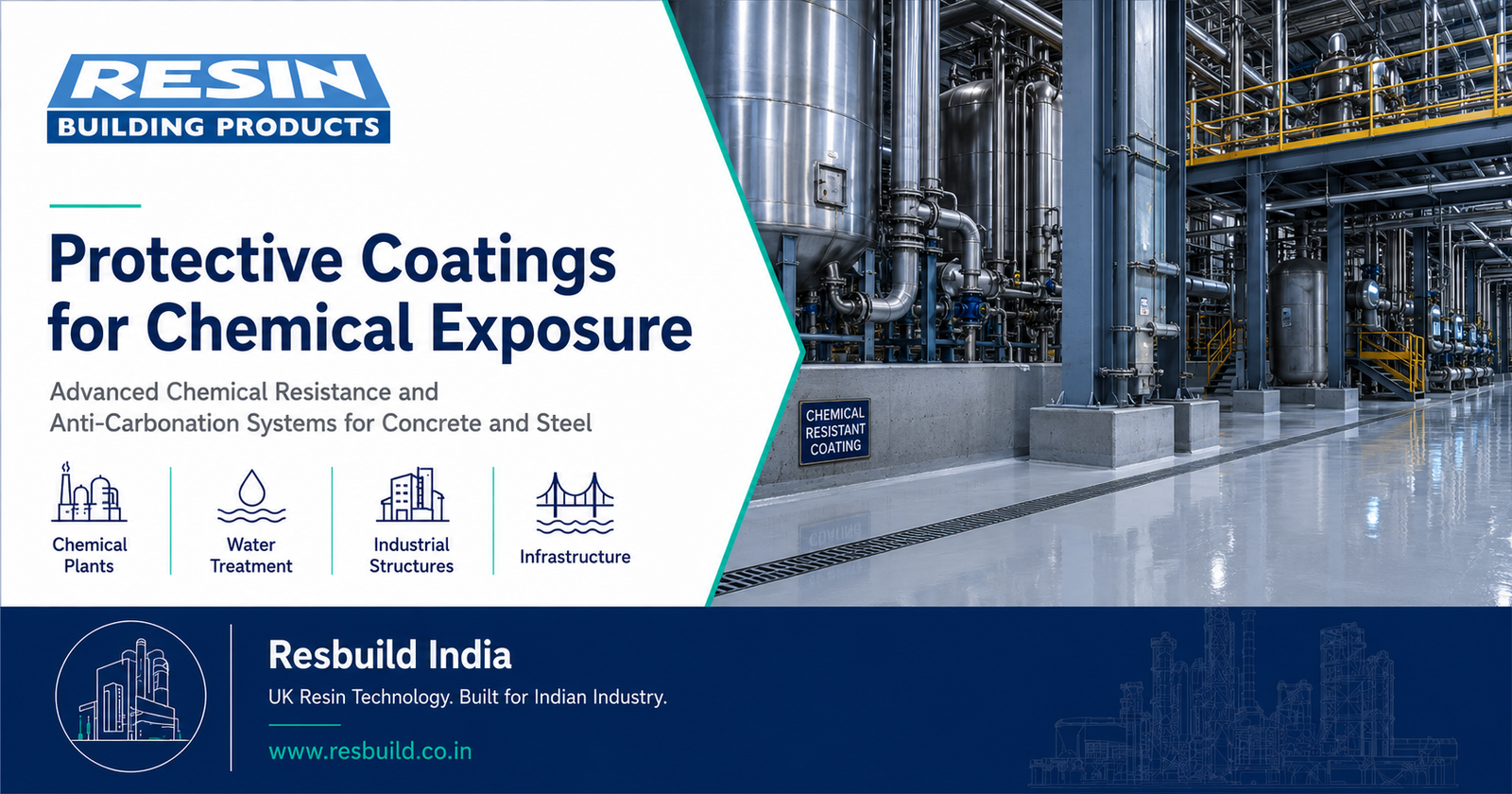
Protective Coatings for Chemical Exposure and Anti-Carbonation Protection
Concrete and steel surfaces in industrial and infrastructure environments are continuously exposed to conditions that can reduce their service life.
Chemical spills, washdown water, vapours, carbon dioxide, moisture, chlorides, weathering, and temperature changes can gradually damage unprotected surfaces. Concrete may become porous, cracked, carbonated, or chemically attacked, while steel may corrode and lose section thickness.
Protective coatings help create a barrier between the substrate and the service environment. However, effective protection depends on correct specification, surface preparation, application, and compatibility with the expected exposure.
Resbuild Protective Coatings provide system-based protection for concrete and steel surfaces exposed to chemical, weather, moisture, and carbonation-related risks.
Why Industrial Surfaces Need Protective Coatings
Concrete is strong in compression, but it is naturally porous. Water, carbon dioxide, salts, chemicals, and contaminants can enter through pores and cracks.
Steel offers high structural strength, but it can corrode when exposed to moisture, oxygen, salts, or chemicals.
Protective coating systems help reduce contact between these substrates and aggressive environments.
Typical reasons for using protective coatings include:
- Chemical resistance
- Moisture protection
- Anti-carbonation protection
- Weather resistance
- Corrosion protection
- Reduced contaminant absorption
- Easier cleaning
- Improved hygiene
- Reduced maintenance frequency
- Extended structural service life
The coating must be selected according to the actual exposure rather than appearance alone.
Understanding Chemical Exposure
Chemical exposure varies significantly between industries and application areas.
A coating in a water treatment plant may face continuous moisture, chlorinated water, cleaning chemicals, and occasional immersion. A chemical processing area may experience acids, alkalis, solvents, oils, or aggressive vapours. A food plant may require resistance to washdowns, cleaning agents, organic acids, and hygiene procedures.
Before selecting a chemical-resistant coating, consider:
- Chemical type
- Concentration
- Contact duration
- Exposure frequency
- Operating temperature
- Possibility of immersion
- Cleaning method
- Substrate condition
- Mechanical traffic
- Required hygiene level
A coating that tolerates occasional splash exposure may not be suitable for continuous immersion or concentrated chemical contact.
What Is Carbonation in Concrete?
Carbonation is a physico‑chemical process in which atmospheric carbon dioxide diffuses into the concrete pore structure and reacts with alkaline hydration products, primarily calcium hydroxide, within the cementitious matrix. In its healthy state, concrete maintains a high alkaline environment (pH ≈ 12.5–13.5), which passivates embedded steel reinforcement. As the carbonation front advances, the pore solution alkalinity progressively decreases. Once the carbonation depth reaches the reinforcement level, the passive oxide film protecting the steel can be destabilized. In the presence of moisture and oxygen, this loss of passivity initiates electrochemical corrosion, leading to reinforcement deterioration and subsequent structural damage.
Corroding steel expands, which can cause:
- Cracking along reinforcement lines
- Concrete delamination
- Spalling
- Rust staining
- Loss of concrete cover
- Reduced structural durability
- Repeated repair requirements
Anti-carbonation coatings help reduce the penetration of carbon dioxide while also providing weather and moisture protection.
How Anti-Carbonation Coatings Protect Concrete
An anti-carbonation coating forms a protective layer over the concrete surface.
A suitable system should help resist carbon dioxide diffusion while allowing an appropriate level of water-vapour transmission, depending on the product and application.
Key performance requirements may include:
- Resistance to carbon dioxide penetration
- Resistance to rain and moisture
- Adhesion to concrete
- Crack-bridging capacity where required
- Weather and UV resistance
- Water-vapour permeability
- Compatibility with repair mortars
- Long-term exterior durability
The coating should be selected as part of a complete concrete repair and protection system.
Chemical Protection for Concrete Surfaces
Chemical Protection for Concrete Surfaces Aggressive chemical exposure can degrade cementitious matrices through softening, erosion, staining, or dissolution. The extent of deterioration is governed by chemical type, concentration, exposure temperature, and contact duration.
Protective coating systems can help protect:
- Process floors
- Bund walls
- Chemical storage areas
- Water treatment structures
- Effluent treatment plants
- Production areas
- Industrial walls
- Concrete tanks
- Utility zones
- Maintenance areas
In severe environments, the complete system may include concrete repair, crack treatment, coving, primer, build coat, reinforcement layer, topcoat, and detailing around penetrations.
Protective Coatings for Steel
Steel surfaces require protection against corrosion and chemical exposure.
The coating system should be selected according to:
- Existing corrosion
- Surface preparation standard
- Atmospheric or immersion exposure
- Chemical contact
- Temperature
- UV exposure
- Required dry-film thickness
- Overcoating interval
- Maintenance accessibility
Steel preparation may involve abrasive blasting, mechanical cleaning, degreasing, and application of a suitable primer before the protective coating.
Applying a high-performance coating over poorly prepared steel can lead to premature failure.
Surface Preparation Determines Coating Performance
Protective coatings depend heavily on substrate preparation.
The concrete surface should be:
- Sound and stable
- Free from laitance
- Free from oil, grease, dust, and contamination
- Repaired where cracked or spalled
- Profiled according to the coating system
- Within the permitted moisture condition
- Free from weak or incompatible previous coatings
Steel surfaces should be prepared to the standard required by the selected system.
Common preparation methods include:
- Diamond grinding
- Shot blasting
- Abrasive blasting
- Mechanical cleaning
- High-pressure washing
- Degreasing
- Removal of failed coatings
- Crack and defect repair
The correct surface profile helps the primer and coating bond effectively.
Important Protective Coating Selection Factors
1. Substrate Type
Concrete, masonry, steel, and previously coated surfaces require different primers and preparation methods.
2. Chemical Resistance
The coating must be compatible with the specific chemical type, concentration, temperature, and contact duration.
3. Moisture Condition
Moisture within concrete can affect adhesion and create blistering or delamination. Moisture-tolerant systems may be required in certain conditions.
4. Mechanical Exposure
Floors may face abrasion, impact, forklift traffic, and wheeled loads. Walls and tanks may have different mechanical demands.
5. UV and Weather Exposure
External coatings must resist sunlight, rain, temperature changes, and atmospheric exposure.
6. Crack Movement
Rigid coatings may not tolerate movement in active cracks. Crack-bridging or flexible systems may be required where movement is expected.
7. Hygiene and Cleanability
Food, pharma, healthcare, and water-treatment environments may require smooth, cleanable, low-absorption surfaces.
8. Application Downtime
Industrial plants may have limited shutdown windows. Curing time, overcoating intervals, and return-to-service requirements should be considered.
Common Protective Coating Failures
Blistering
Blistering may result from moisture vapour, osmotic pressure, contamination, trapped air, or incorrect application conditions.
Delamination
This can occur because of weak substrate, poor preparation, incompatible primer, moisture, or contamination.
Chemical Softening
The coating may soften or swell if it is exposed to a chemical outside its resistance range.
Cracking
Cracking may be caused by substrate movement, excessive coating thickness, temperature variation, or insufficient flexibility.
Pinholes
Pinholes may allow chemicals or moisture to reach the substrate. They can result from porous concrete, air release, poor application, or insufficient coat thickness.
Early Weathering
External coatings may fade, chalk, or lose performance if they lack suitable UV and weather resistance.
Typical Applications of Resbuild Protective Coatings
Resbuild Protective Coatings may be considered for:
- Chemical plants
- Water and wastewater treatment plants
- Process areas
- Industrial floors and walls
- Concrete tanks
- Bunds and containment zones
- Steel structures
- Parking structures
- Bridge and infrastructure concrete
- External façades
- Industrial maintenance projects
- Anti-carbonation protection
- Weather-exposed concrete
- Utility and service areas
Product selection must be based on substrate, exposure, application method, and required performance.
A Complete Concrete Protection Framework
Protective coating should normally be the final stage of a complete maintenance process.
A typical system may involve:
- Condition assessment
- Identification of chemical and environmental exposure
- Removal of weak concrete or failed coating
- Reinforcement treatment
- Crack and spalling repair
- Surface profiling
- Moisture assessment
- Primer application
- Protective coating installation
- Inspection and maintenance planning
Skipping repair or preparation stages can reduce coating life.
Why System Specification Matters
A protective coating is not simply a paint layer.
A complete specification should define:
- Surface preparation
- Repair materials
- Primer type
- Number of coats
- Required thickness
- Application method
- Recoat interval
- Curing conditions
- Chemical resistance
- Inspection criteria
- Maintenance procedure
This approach helps ensure that the coating is suited to the operating environment and applied consistently.
Resbuild Protective Coatings
Resbuild India supports chemical plants, water-treatment facilities, contractors, maintenance teams, consultants, and industrial owners with protective coating systems for concrete and steel.
Our technical selection approach considers:
- Chemical exposure
- Carbonation risk
- Moisture and weather conditions
- Substrate type
- Surface condition
- Mechanical wear
- Required finish
- Application downtime
- Service-life expectations
For correct product selection, refer to the relevant technical data sheet and project specification.
Request Technical Guidance
Need a protective coating for chemical exposure, concrete weathering, steel corrosion, or anti-carbonation protection?
Connect with Resbuild India for:
- TDS and SDS
- Chemical-resistance guidance
- Site consultation
- System recommendations
- Surface-preparation guidance
- Applicator inquiry
- Distributor inquiry
Product page:
https://resbuild.co.in/resbuild-protective-coating
Contact:
+91 98796 13029
Resbuild India
UK Resin Technology. Built for Indian Industry.
Frequently Asked Questions
What is an anti-carbonation coating?
An anti-carbonation coating is a protective coating designed to reduce the penetration of atmospheric carbon dioxide into concrete.
Why is carbonation harmful to reinforced concrete?
Carbonation can reduce concrete alkalinity around reinforcement. When moisture and oxygen are present, this can increase the risk of steel corrosion and concrete spalling.
Can one protective coating resist every chemical?
No. Chemical resistance depends on the chemical type, concentration, temperature, exposure duration, and coating formulation.
Can protective coatings be applied over damaged concrete?
Damaged, cracked, weak, or spalled concrete should normally be repaired and correctly prepared before coating application.
What causes protective coating delamination?
Common causes include poor surface preparation, contamination, moisture, weak substrate, incompatible primer, or application outside recommended conditions.
Are protective coatings suitable for steel?
Yes, selected systems can protect steel surfaces, but steel preparation and primer selection are critical.
Can anti-carbonation coatings bridge cracks?
Certain coating systems may provide crack-bridging performance. The required capability depends on crack width and movement and should be verified in the TDS.
How is coating thickness controlled?
Wet-film and dry-film thickness can be checked using suitable inspection tools according to the coating specification.
Suggested Internal Links
- Concrete Repair & Protection
- Industrial Resin Flooring
- Surface Treatments & Sealers
- Waterproofing Systems
- Contact Resbuild India